Going to a Finish Line with Mark0
After a bunch of updates and some solid troubleshooting, I think I’m finally reaching the finish line with ESP32 Mark0.
This project has grown a lot since it started. What began as a simple embedded experiment turned into a full IoT setup — complete with a web dashboard, data communication, and custom hardware. Today was especially productive.
🔧 Final Touches and Fixes
One of the first things I tackled was cleaning up how often different parts of the code update. Previously, it was a bit messy — everything ran on the same interval. Now I’ve split them up so each part can update at a more sensible pace:
1
2
3
4
const unsigned long BLYNK_INTERVAL = 5 * 60 * 1000;     // 5 minutes
const unsigned long WEATHER_INTERVAL = 5 * 60 * 1000;   // 5 minutes
const unsigned long EINK_INTERVAL = 3 * 60 * 1000;      // 3 minutes
const unsigned long FLASK_INTERVAL = 30 * 1000;         // 30 seconds
Much cleaner. Now, things like the E-Ink display or Blynk updates don’t crowd each other or flood the network.
🌐 Flask + Web Dashboard
The big highlight today was getting the web dashboard working. I used Flask and Flask-SocketIO to set up a live interface that shows data from the ESP32. The ESP sends info over Wi-Fi, and Flask picks it up and displays it on the web.
Of course, getting everything to talk to each other wasn’t totally smooth — my PC is on a wired LAN, and the ESP32 is on Wi-Fi, so there were some annoying network issues to untangle. But once I got them talking… it just worked!
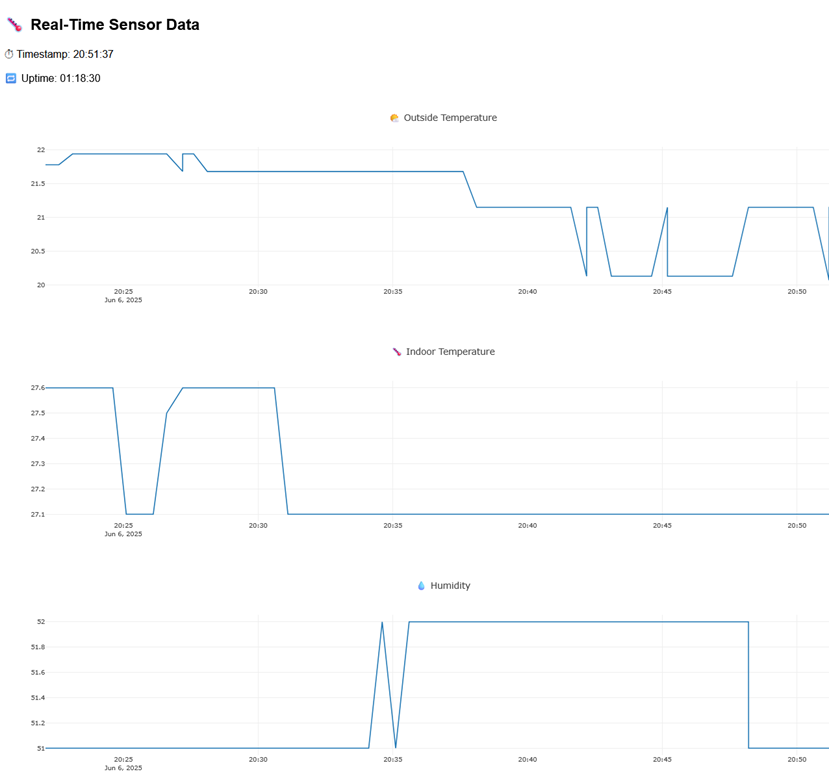
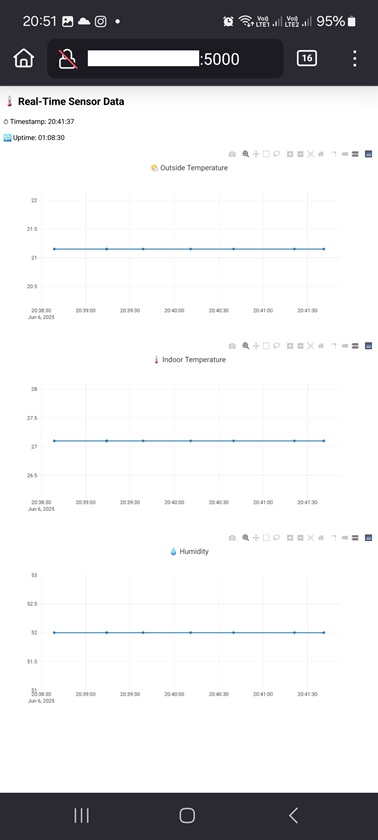
The web interface came up, data started flowing, and the layout started looking pretty slick. There was a moment of confusion over which temperature was “inside” and which was “outside” — but that was fixed pretty quickly.
Here’s how it looked on my monitor:
And here’s a shot from my phone:
📝 Repo Cleanup
Also took a bit of time to clean up the repo:
- Updated the
README.mdto reflect the current structure and environment (Arduino IDE, USB-C, Flask, etc.) - Updated the
LICENSEfor clarity
Small but important stuff, especially if anyone else ends up using this project.
🤯 Reflecting on Mark0
At this point, I feel like I’ve squeezed pretty much everything I can out of Mark0. It’s impressive how much I was able to learn and build with just an ESP32, some basic components, and a custom PCB.
From hardware design in KiCad, to live web updates over Wi-Fi — this board delivered way more than I expected.
⏭️ What’s Left
There are just two final things I want to wrap up before truly calling Mark0 “done”:
- Get the Python/Flask program running as a background service (so it survives reboots)
- Make the webpage store and show some history of the data (e.g. temperature trends)
Once that’s in place, I’ll be ready to start thinking about Mark1 — and I already have ideas brewing 😎
Thanks for following along!
— Z